

What Radiologists Wish More People Understood About The Profession
Published
August 18, 2026
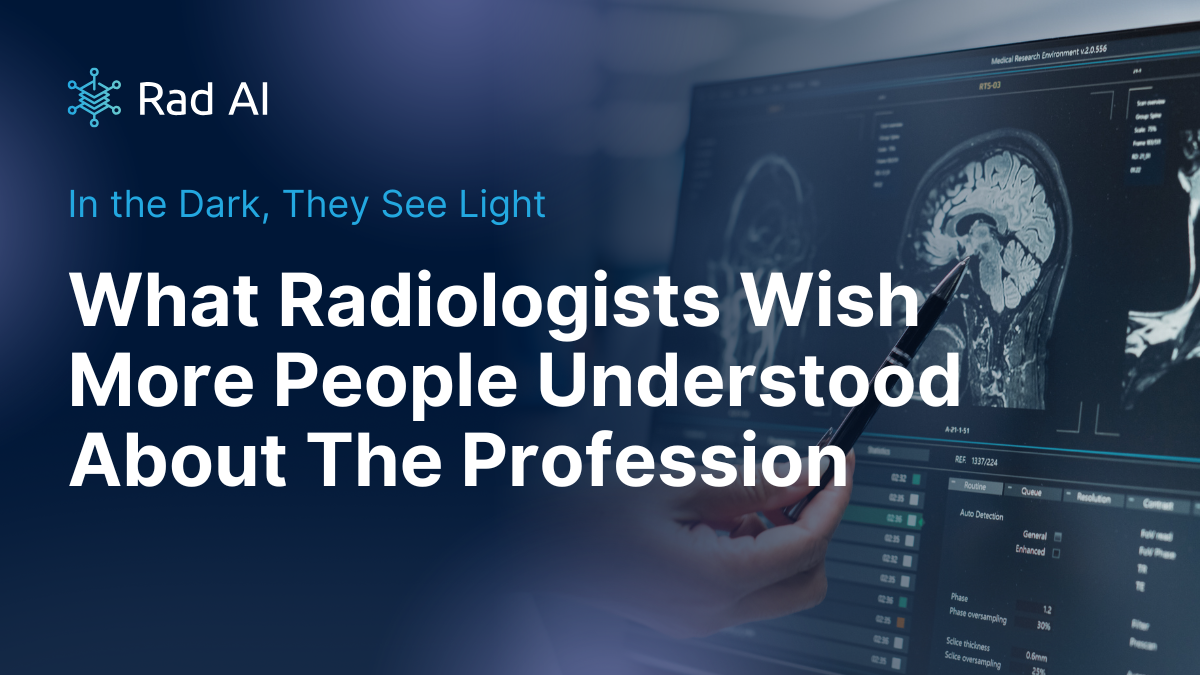

The public conversation about radiology has been dominated for years by one question: Will AI replace radiologists? It has generated headlines, conference panels and no shortage of debate. What it hasn’t generated, for the most part, is actual concern among radiologists.
Recently, the Rad AI team interviewed 12 of them — residents and department chairs, diagnosticians, interventionalists and teleradiologists — and asked them to describe their work in their own words. What they said isn’t what the headlines reflect.
They Chose Radiology Because of What It Offers
The replacement narrative implicitly treats radiology as a set of tasks, from pattern recognition and image reading to report generation, that could theoretically be automated. What the radiologists we spoke with described was something completely different.
Divya Kumari, MD, interventional radiologist in Illinois, shared what drew her to the field: "It's almost like reading someone's hand, like a fortune. I feel like that's what radiology is to me — and that fascinates me. You can give me a CT scan or ultrasound, and I can tell you so many things about a patient without even meeting them."
"You're given a piece of the puzzle, which are the images of these patients," said Jay Gupta, MD, a radiology resident in Ohio. "Using the clinical history and labs, you have to help the referring provider come up with what's wrong with them."
These are physicians who chose a field because of its intellectual demands, and who find meaning in exactly the kind of synthesis that a worklist-driven, volume-first system increasingly makes difficult to do well.
Burnout Is Only Part of the Problem
Medscape's 2024 survey found that 51% of radiologists are experiencing burnout. That figure appears in workforce reports and conference presentations, usually followed by discussion of wellness initiatives, flexible scheduling and resilience programs. What it’s rarely followed by is an honest accounting of what is actually causing it.
The answer, from the people doing this work every day, points somewhere specific. "We’re essentially killed by inefficiencies," said Jean Jeudy, MD, a professor and vice chair for informatics in Maryland.
Poor EHR integration, studies arriving with inadequate clinical context and referring physicians ordering imaging without clear indication — these are issues that no wellness initiative can touch because it isn't a radiologist’s personal failing but a systemic one.
What this does over time was described by Elizabeth Bergey, MD, Chief Clinical Officer at Rad AI and a former pediatric radiologist: "Many radiologists aren’t able to get the work done, and that's introducing a sense of failure into their psyche." When the structure around a radiologist makes it difficult to practice at the level they trained for, the cost is professional identity, not just workflow efficiency.
There’s also a different challenge — the impact of being removed from the outcome of your own work. "It can get very discouraging. Because for me, I love that personal aspect, seeing the patient progress with the correct diagnosis," said Rhett Smith, MD, a teleradiologist in Utah.
"I'm a social person, and I also went into medicine to help people. And so to not be involved in that aspect and to share in the joy of somebody, either finally getting a correct diagnosis or getting a diagnosis that was vital to their care, it's difficult. It's been the most difficult part of radiology for me," he said.
This isn’t a complaint about the nature of the specialty but rather a description of a gap between the work radiologists do behind the scenes and the feedback loop with patient-facing clinicians that would make their work feel even more meaningful.
On AI, They’re Ahead of the Conversation
The replacement debate peaked around 2016 and has been slowly deflating ever since, as radiologists predicted it would. What has replaced it, among practitioners actually using these tools, is a more specific and more useful question: What does AI actually fix?
"The biggest impact I've seen has been with impression generation. It provides a short break in cognitive workload, and is customized to exactly what I would normally say. At the end of a shift, I feel less tired, less fatigued than I otherwise would," said Jeff Chang, MD, Co-Founder and Chief Product Officer of Rad AI and a former practicing radiologist.
A study of 21 radiologists at Colorado Imaging Associates following Rad AI Impressions implementation found an 80% reduction in words dictated per impression and a 30% reduction in time spent on impressions.
Dr. Bergey described the structural outcome: "Instead of being kind of a widget maker, they're going to be more of a professor." The radiologist is a consultant, teacher and expert, which is what they have always understood themselves to be rather than a processor of volume.
Among the next generation entering the field, the future is obvious. Kaustav Bera, MD, a body imaging fellow in Ohio whose research background is in AI and cancer imaging, put it plainly: Radiologists who don't adopt AI will be left behind, but radiologists themselves, with AI as a partner, will be better for it.
What They Wish Non-Radiologists Understood About Radiology
What many of the interviewees noted was a misalignment between reality and expectations of the profession, and it comes down to this: Radiology isn’t a service you use, it’s a physician you consult.
The moment it gets treated as the former — as a line item, a throughput function or a department to be optimized — you lose access to what it actually is. "There's so much that you can offer in the hospital," said Dr. Kumari. "And I feel like it's quite underrated."
That underrating is the problem, but AI is the first tool in a long time that frees radiologists to practice as the physicians they are, rather than what the system has made them.
This is part of a series drawn from original interviews conducted with 12 radiologists across career stages, subspecialties and practice settings. Quotes have been edited for brevity and clarity.

Expand Your Expertise
More Blogs
The Readout explores the technologies, challenges and realities shaping where care goes next.
%20(1).png)
Radiology-First AI
Radiology-first AI that works in the real world.
Built For How Radiology Actually Works
Built for Radiology. By Radiologists.