

AI Conversations to Follow at RSNA 2026
Published
November 5, 2026

What should patients know about AI in their care? Where can it improve radiology workflows? And what should a department ask before investing?
At RSNA 2026, physicians from organizations we’re proud to count as Rad AI partners will help answer these questions. Their sessions explore how AI is being evaluated, adopted and experienced across radiology.
These are just a few of the many voices from our customer and partner community presenting this year. We’re proud to see their expertise represented throughout the program and look forward to several days of learning and conversation in Chicago.
Where Can AI Help in Emergency Radiology?
Before a radiologist interprets an examination, protocoling and workflow decisions have already shaped its path. Where can AI make that process better?
Melissa A. Davis, MD, MBA, of Yale University will explore that question as a moderator of “AI in Emergency Radiology: What Works, What Fails and Why” and presenter of “AI-Assisted Protocoling and Workflow Optimization in the Emergency Department.” The session also addresses acute-finding detection, liability and human oversight.
Sunday, Nov. 29 | 10:30–11:30 a.m. | S406B
View Session
Is AI Improving Care, and What Do Patients Want From It?
A faster workflow is easy to appreciate on a busy shift. Understanding what that improvement means for patients requires a wider lens. In the session, “AI and Patient Care in Radiology: Promise, Practice, and Pitfalls,” Jordan D. Perchik, MD, of the University of Alabama at Birmingham will address “What Patients Want from AI in Imaging: Trust, Transparency and Communication.”
Tuesday, Dec. 1 | 1:30–2:30 p.m. | S503
View Session
Does AI Work for the Patients You Actually Serve?
The patients represented in a training dataset may differ from those arriving for imaging. How can organizations account for that gap when AI-derived findings enter clinical care?
Judy W. Gichoya, MBChB, MS, of Emory University will examine this question in “Biomarkers for Everyone: Closing the Gap Between Who AI Was Trained on and Who It Serves.” Her presentation is part of “Imaging Biomarkers at Scale: Building Programs That Actually Deliver Care,” a session connecting equitable AI performance with the practical work of moving imaging biomarkers into clinical workflows.
Wednesday, Dec. 2 | 1:30–2:30 p.m. | E450B
View Session
What Should Radiologists Ask Before Buying AI?
Evaluating AI means translating a promising capability into a purchasing decision. What should radiologists look for, and what should give them pause?
Elias Kikano, MD, of Emory University will address those questions in “AI Procurement for Radiologists: RFPs, Red Flags and Reality Checks.” Part of “The Business of Radiology AI: Procurement, Pricing Models and Proof,” the presentation sits alongside discussions of pricing, reimbursement and a changing market.
Thursday, Dec. 3 | 8–9 a.m. | E450B
View Session
What Makes AI Useful in a Radiologist’s Daily Work?
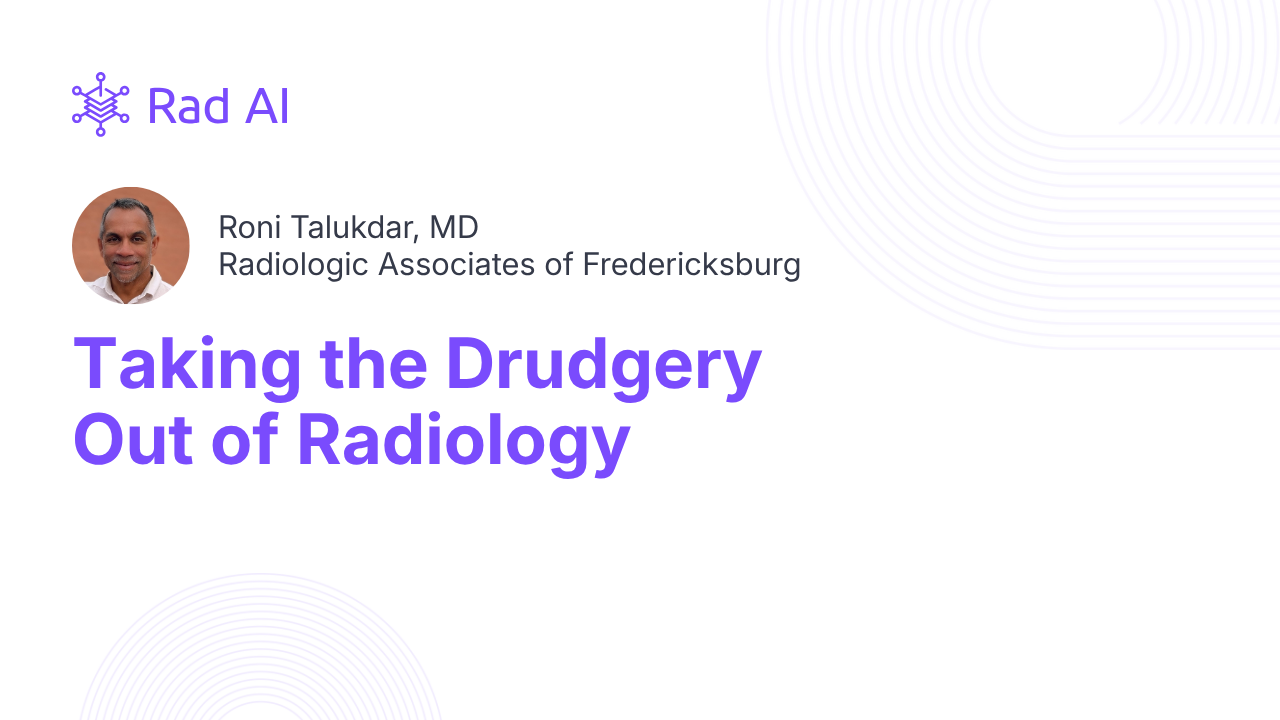
At the AI Theater, Roni F. Talukdar, MD, of Radiologic Associates of Fredericksburg (RAF), and Elizabeth A. Bergey, MD, will explore this question in Rad AI’s “AI Is the Means, Not the Mission: Building Reporting Around Radiologists.”
Grounded in RAF’s experience with Rad AI Reporting, the discussion will examine adoption, workflow and how to assess whether AI delivers measurable value in routine practice.
Tuesday, Dec. 1 | 3–3:20 p.m.
AI Theater, South Hall A, Level 3, Booth 5536
View Session
This industry session is presented by Rad AI and is not accredited for CME.
Continue the Conversation With Rad AI
Exploring what AI could do for your organization? Book a meeting with the Rad AI team at RSNA to discuss your priorities, see our solutions and talk about where AI could help your radiologists.

Expand Your Expertise
More Blogs
The Readout explores the technologies, challenges and realities shaping where care goes next.

Radiology-First AI
Radiology-first AI that works in the real world.
Built For How Radiology Actually Works
Built for Radiology. By Radiologists.