

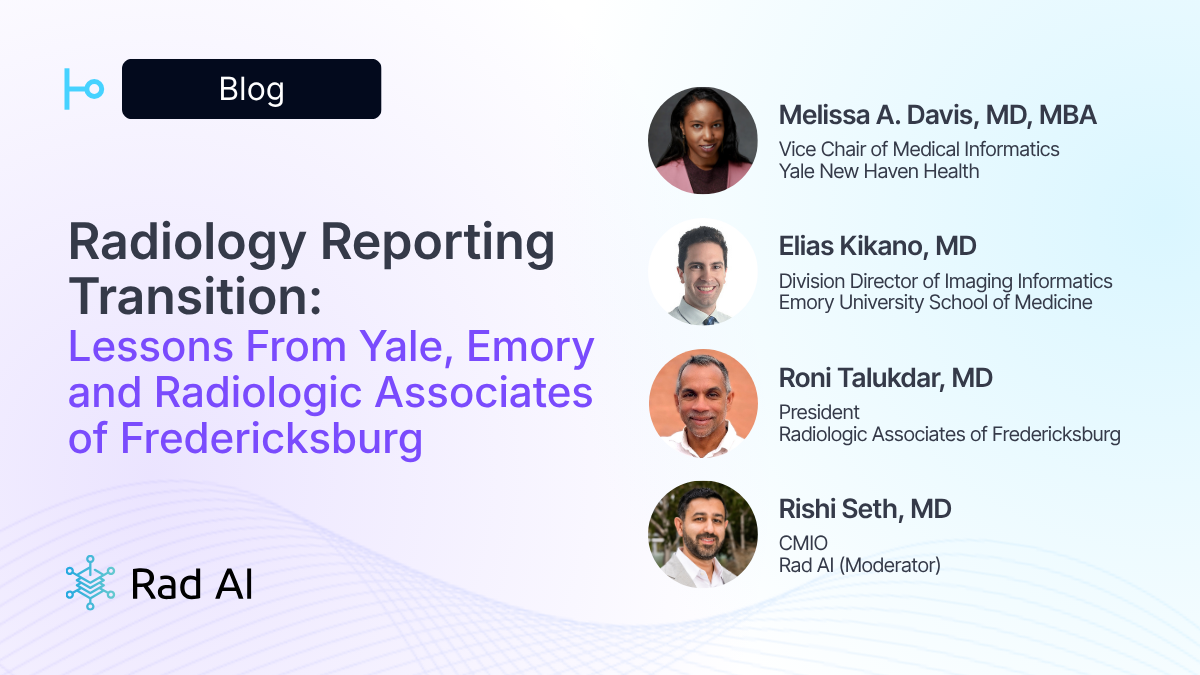
Radiology Reporting Transition: Lessons From Yale, Emory and Radiologic Associates of Fredericksburg
Published
July 31, 2026
.jpeg)
Radiology organizations are facing growing pressure from every direction. Imaging volumes continue to rise while workforce shortages leave fewer radiologists available to meet demand. At the same time, PowerScribe® 360’s end-of-life announcement is accelerating decisions about infrastructure that many organizations have relied on for decades.
These deadlines aren’t the only reason organizations are considering a change. Frustration with innovation-stagnant legacy systems and inefficient workflows has been building for years.
In a recent webinar, three radiology leaders shared firsthand lessons from navigating a reporting transition:
- Melissa A. Davis, MD, MBA, Vice Chair of Medical Informatics at Yale School of Medicine and Yale New Haven Health (Yale)
- Elias Kikano, MD, Division Director of Imaging Informatics at Emory University School of Medicine (Emory)
- Roni Talukdar, MD, President of Radiologic Associates of Fredericksburg (RAF)
They shared what prompted the reporting transition, the questions and concerns they faced, what proved harder than expected, what went well and what they learned along the way.
Decision: When Was It Time to Change Your Reporting Platform?
“Change is terrifying, right? The fundamental thing is radiologists are both innovative but also conservative,” said Dr. Talukdar.
For RAF, the impending radiologist shortage changed the calculation. With more radiologists retiring than entering the workforce, the potential to improve efficiency and meet rising demand made the disruption worthwhile.
Emory faced similar workforce pressure alongside rapid health system growth, including the recent acquisition of two hospital systems in southern Georgia.
“We started to feel the constraints there from the [legacy] systems not being able to advance, not keeping up on the efficiency side for the radiologists as well as scale appropriately for the health systems,” shared Dr. Kikano.
Replacing it was already on the roadmap, but end-of-life announcements created a firm deadline and elevated the initiative above competing priorities.
Yale’s decision grew out of years of frustration rather than a single event. Its IT team began exploring the market early, but making the transition a systemwide move required alignment across academic and private practices, radiology leadership, administration and finance.
Evaluation: What Matters Beyond Product Features?
For Yale and RAF, choosing a reporting platform also meant evaluating the relationship behind it.
“What does your support look like one year from now, five years from now, 10 years from now? Because what we really want is a partner,” said Dr. Davis.
Trust was especially critical for RAF, which was simultaneously unifying nine hospitals and seven PACS environments under an accelerated four-and-a-half-month timeline. The practice needed a partner that would be candid about what was achievable, step up when challenges arose and work collaboratively through them.
“The idea that no matter what relationship you enter into, there's going to be missteps, there's gonna be bumps in the road, there are gonna be things that don't go as planned. But how do partners fundamentally function in a way that's collaborative, that's constructive, that moves forward?” shared Dr. Talukdar.
Their experiences reinforce that organizations should evaluate not only what a platform can deliver today, but how the team behind it will respond when plans change or problems emerge.
Implementation: How Can Organizations Prepare for the Unexpected?
Across all three organizations, clear expectations and communication proved as important as the technology.
Under RAF’s compressed timeline, Rad AI, RAF and its PACS vendor defined responsibilities and maintained frequent touchpoints. This helped the teams resolve setbacks collaboratively rather than resorting to finger-pointing.
At Emory, clearly defined requirements helped accelerate the implementation timeline.
“I think what's been the easiest is, again, how Rad AI’s implementation team has made it really straightforward on what the parameters are, what technical stuff that needs to be put in place … the implementation team had budgeted six to eight weeks for it, and we were able to finish it in two weeks, which is unheard of,” shared Dr. Kikano.
Yale’s greater challenge was accounting for differences across specialties, with some needs only surfacing once the platform was in use.
“The rubber hits the road once you’re live fully, and then all those kinds of things that you probably didn’t think about post-deployment start to surface,” said Dr. Davis.
Rad AI’s on-site support helped Yale address many of those issues during the first week, while continued communication supported ongoing optimization after go-live.
What a Successful Reporting Transition Requires
The experiences of Yale, Emory and RAF point to three requirements for a successful reporting transition:
- a shared vision for what success looks like
- cross-functional ownership grounded in realistic expectations
- a trusted partner that communicates and adapts as challenges emerge
Ultimately, the success of a reporting transition comes down to a better radiologist experience or, as Dr. Kikano put it: “Happy radiologists.”
Watch the full webinar to hear more firsthand lessons from the leaders who’ve navigated the transition.

Expand Your Expertise
More Blogs
The Readout explores the technologies, challenges and realities shaping where care goes next.


.png)
Radiology-First AI
Radiology-first AI that works in the real world.
Built For How Radiology Actually Works
Built for Radiology. By Radiologists.