

Less Hype, More Help: Reflections on Testifying Before the U.S. Senate on AI in Healthcare
Published
March 26, 2026
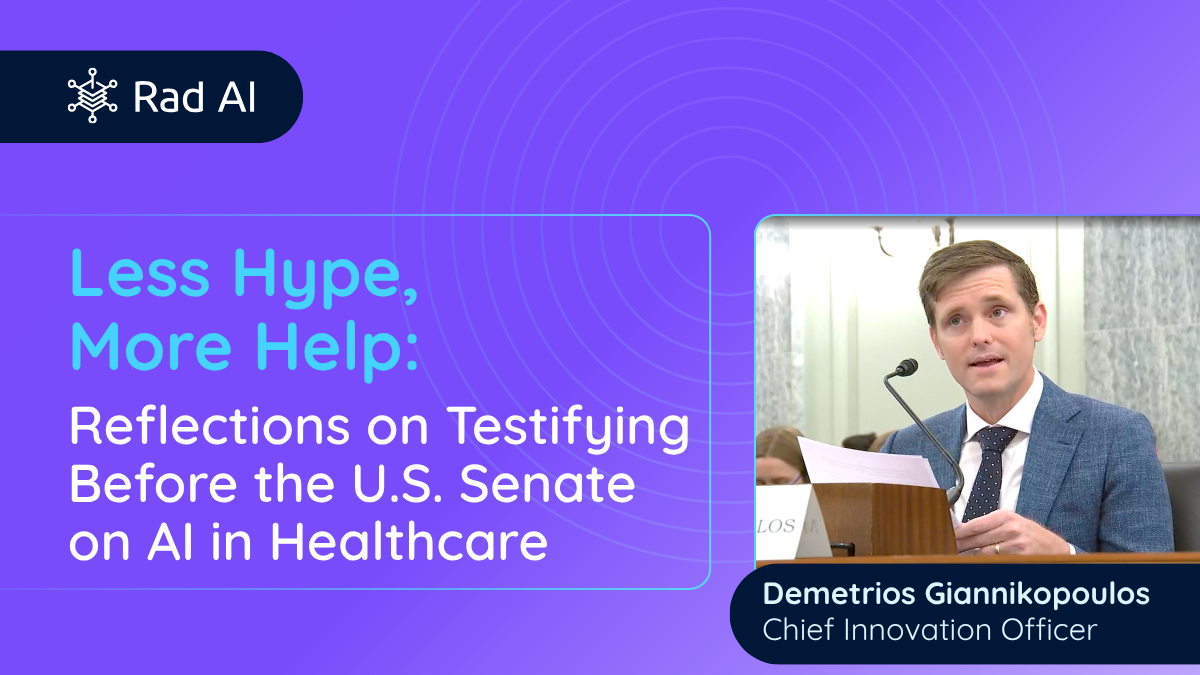

Two weeks ago, the U.S. Senate Commerce Subcommittee on Science, Manufacturing, and Competitiveness held a hearing on the future of artificial intelligence across multiple sectors of the economy.
I testified before the subcommittee alongside witnesses from manufacturing, robotics and academia, each discussing how AI is shaping their respective industries, while my focus was on healthcare and the role AI can play in strengthening clinical care.
What I did not fully appreciate until this week is how quickly something like this can come together. I was asked to testify the Monday prior, and the days that followed were filled with thoughtful conversations with Senate staff offices as we prepared for the hearing.
What struck me most in those conversations was how serious and practical they were. The questions were not about hype or headlines, but about the realities of deploying these technologies safely in the real world:
- How do we ensure patient safety as AI systems scale?
- How do we monitor performance after deployment, not just before approval?
- How do we train clinicians and clearly communicate both the intended use and the limits of these systems?
- How do we support clinicians and the healthcare workforce rather than replace them?
Across those conversations and during the hearing itself, there was notable bipartisan alignment around a central idea: innovation and responsible guardrails must move forward together.
Senator Marsha Blackburn captured that dynamic clearly during the hearing when she observed that “HIPAA needs to be modernized… it covers the fax and the fax machine, the paper and the fax machine.” Her comment reflected a broader point that surfaced repeatedly during the discussion: many of the regulatory frameworks governing healthcare technology were designed for a very different era.
Updating those frameworks is not about slowing innovation, but about creating the clarity and confidence needed for responsible adoption. Clear rules of the road do not slow innovation; they make large-scale adoption possible.
The broader discussion also made clear that the challenge is not simply AI adoption, but how these systems can be deployed safely and effectively across industries.
Witnesses, including Brittany Ng of Siemens and Damion Shelton of Agility Robotics, described how AI is already transforming manufacturing and logistics. AI-enabled digital twins are allowing shipbuilders to simulate entire production systems before construction even begins, while robotics companies are using machine learning to automate repetitive physical tasks and expand workforce capacity in sectors already facing labor shortages.
What that discussion reinforced is that while much of the public conversation about AI focuses on chatbots and software tools, a large portion of the real transformation is happening in the physical economy as well.
Across sectors, the theme was remarkably consistent: the most effective AI systems are not the ones attempting to replace human expertise, but the ones designed to strengthen it.
Healthcare is a particularly clear example of this dynamic.
During my testimony I focused on one of the most urgent challenges facing the healthcare system: diagnostic accuracy. Research from Johns Hopkins estimates that nearly 800,000 Americans each year die or are permanently disabled due to diagnostic error.
At the same time, the healthcare workforce is already under significant strain. The United States has roughly 900,000 physicians today, while projections estimate a shortage of nearly 187,000 physicians by 2037. Nursing shortages are expected to reach nearly 200,000 by the end of the decade, even as imaging volumes continue to rise dramatically.
In that environment, the question is not whether technology will replace clinicians. The real question is how we support the clinicians we have so they can safely care for the growing number of patients who need them. In many ways, AI has the potential to act as a pressure-release valve within that system.
In radiology, for example, AI can rapidly analyze imaging to flag potential findings for immediate review. Clinical evidence can be integrated directly into a physician’s workflow, strengthening confidence in a diagnosis, while communication and documentation tools can help ensure that care teams move quickly when urgent findings are identified.
Just as importantly, these systems can help ensure patients do not fall through the cracks after the immediate clinical moment has passed. A scan performed for one reason may reveal an incidental finding that requires follow-up months later. Today more than half of patients never receive recommended follow-up care, a gap that AI systems can help address by tracking those findings and ensuring care continues.
In other words, the purpose of this technology is not to replace physicians, but to enable them to do the work they trained their entire lives to do.
For me, this discussion is also deeply personal, shaped in part by my own experience as a patient and as a caregiver. It took more than a decade for me to receive my own diagnosis of multiple sclerosis, and I have also supported my wife through cancer treatment. Experiences like these inevitably change how you see the healthcare system.
Behind every policy debate, every algorithm and every regulatory framework is something very simple: a patient waiting for answers.
The technology is advancing quickly, but the objective is ultimately straightforward. Artificial intelligence will not solve every challenge in healthcare, but it can help clinicians reach the right diagnosis faster, coordinate care more effectively and reduce the burden placed on an already strained workforce.
While my testimony focused on healthcare, one thing became clear throughout the hearing. Whether the discussion was about robotics, manufacturing or medicine, each witness ultimately described a variation of the same principle: AI works best when it supports people.

Expand Your Expertise
More Blogs
The Readout explores the technologies, challenges and realities shaping where care goes next.
Radiology-First AI
Radiology-first AI that works in the real world.
Built For How Radiology Actually Works
Built for Radiology. By Radiologists.