

What Radiology AI Looks Like Around the World
Published
March 3, 2026
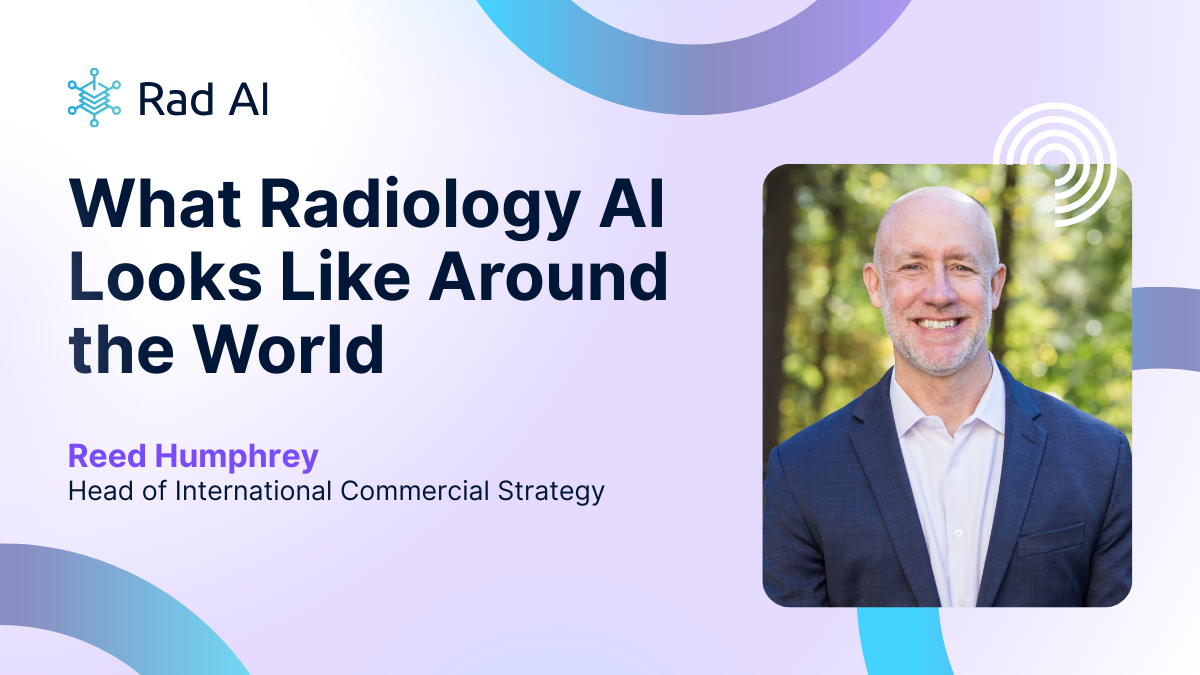
.jpeg)
Despite wide variation in healthcare around the world, radiology teams face a strikingly similar set of pressures: rising imaging volumes, limited workforce capacity, and growing burnout.
In this Q&A, Reed Humphrey, Head of International Commercial Strategy at Rad AI, draws on more than 13 years of experience in radiology AI and workflow technologies to examine how these challenges manifest across countries, what determines successful adoption, and how buying decisions are evolving over time.
When you look across different countries and U.S. health systems, what challenges in radiology feel universal, and where do they diverge most?
The overarching global theme is the need for radiologists to save time, work more efficiently, and reduce fatigue and burnout. Rad AI is well-positioned to address these challenges as our generative AI solutions can save radiologists one to two hours per shift, allowing them to get more done while feeling less stressed and fatigued.
Where we see needs diverging is in the field of diagnostic, pixel-based AI. Western countries have been slower to adopt diagnostic algorithms because they don’t typically save the radiologist time, and it’s often hard to prove the return on investment. Whereas many non-Western countries have embraced diagnostic algorithms as a way to quickly triage and diagnose patients, especially in remote or rural markets that have less access to high-end scanning equipment and fellowship-trained radiologists.
What’s something radiology teams often get hung up on during AI evaluation that, in your experience, doesn’t actually determine whether adoption will be successful?
Data ownership. Many radiology practices and health systems are preoccupied with owning and controlling their data, which makes them naturally skeptical of sharing and collaborating with AI vendors. This skepticism often holds them back from pursuing promising AI partnerships that need certain data sets to train their models and/or to continuously improve their products.
What’s a question you wish radiology leaders would ask more often, but rarely do?
What evidence does a vendor have to substantiate their claims of improved performance, quality, time savings, and ROI?
How have radiology buying conversations changed over the past year, three years, and five years?
The landscape has changed dramatically. I remember speaking at a conference a few years ago, where I asked 150 radiology C-suite executives to raise their hands if their organizations were using any radiology AI applications in live clinical production. Not one person raised their hand.
Now, virtually every single imaging organization is actively evaluating and/or already using multiple AI solutions in their environments. This represents a sea change over the past few years, and it’s a predictive indicator of where things are heading in the future.
What’s the biggest shift you’re seeing in how radiology leaders evaluate ROI today compared to even a year ago?
In recent years, radiology organizations have piloted and or purchased a wide range of AI products based on the promise of what these products might be able to deliver. We’ve learned enough now that organizations have become wary of the promises and more focused on the proof. There’s less of an appetite to evaluate cool, shiny AI products and more emphasis and rigor placed on identifying products that have proven value and measurable ROI.
Continuing the Conversation
Across markets, radiology leaders are becoming more disciplined in how they evaluate AI. As Humphrey’s perspective shows, successful adoption, whether domestic or international, hinges on demonstrable time savings, reduced burnout, and measurable ROI.
That same focus surfaced in our recent Q&A with Ryan Hood, VP of Engineering at Rad AI, where he shared how the most important measure of a product is its ability to deliver and prove meaningful efficiency gains for radiologists. Read the Q&A here.
If you’re thinking through international expansion or tracking how radiology AI buying decisions are evolving, Humphrey welcomes the conversation and can be reached at reed.humphrey@radai.com.

Expand Your Expertise
More Blogs
The Readout explores the technologies, challenges and realities shaping where care goes next.
.png)
.png)

Radiology-First AI
Radiology-first AI that works in the real world.
Built For How Radiology Actually Works
Built for Radiology. By Radiologists.