

Does Radiology Have a PR Problem?
Published
July 29, 2026
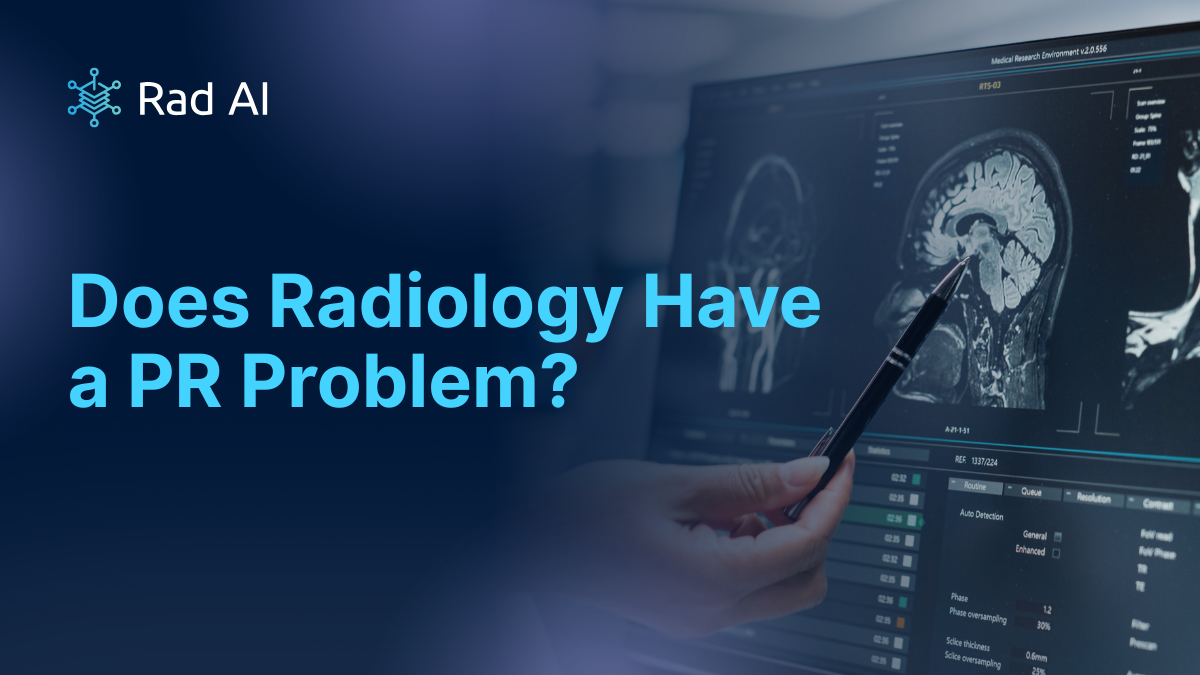

Every few months, some version of the same question comes back around: Will AI replace radiologists?
Raise your hand if you’re exhausted by this narrative because the same version of the story emerges every time.
Some executive, thought leader or futurist predicts that radiologists will be easily replaced by AI. The media jumps on it. Radiologists explain, again, why that isn’t possible. The conversation quiets down until we do it all over again three months later.
Technology changes. Models get better. But the framing rarely evolves. Radiologists are still positioned as waiting to be automated out of their jobs.
It’s a compelling headline and a deeply incomplete account of what’s happening in radiology.
So, does radiology have a PR problem?
I ask partly in jest, having spent much of my career in PR and communications. I naturally pay attention to the narratives that take hold, who benefits from them and why some persist even when the facts are far more nuanced.
But beneath the humor is a serious question: Why does radiology face such relentless scrutiny in the AI conversation when other medical specialties don’t?
AI is already influencing documentation, clinical decision support, surgery, pathology and many other areas of medicine. Yet we don’t see the same persistent questions about whether it will eliminate cardiologists, primary care physicians, oncologists or surgeons.
Radiology is different. The work is highly digitized. Images can train and test models. Performance can be benchmarked. From the outside, the work can look like a contained transaction: an image goes in, a report comes out. That makes radiology easy to package into a technology story and unusually easy to oversimplify.
The replacement narrative assumes that a radiologist’s primary value is spotting an abnormality. Once an AI system can identify the same abnormality, the physician begins to look unnecessary.
That premise ignores much of the job.
Radiologists synthesize patient history, prior imaging and information that may be incomplete, contradictory or still evolving. They determine which findings matter, communicate urgent results, consult with clinicians and help shape what happens next. They make judgment calls in situations where technical accuracy alone doesn’t answer the clinical question.
AI may perform portions of that work exceptionally well. In some cases, it already does. That doesn’t make the physician responsible for the full interpretation, context and communication interchangeable with the technology.
This is where the communications challenge becomes more complicated.
When someone claims AI will replace radiologists, the natural response is to explain what AI can’t do. It can’t understand the full patient context, manage ambiguity, consult with the care team or assume clinical responsibility. Those points matter, but they also leave radiology responding to a premise someone else established.
One of the realities of communications strategy is that repetition is incredibly powerful. The more often a narrative is repeated, the more familiar it becomes. That familiarity has a funny way of creating credibility, and before long, people stop questioning the premise and start debating the details.
That is exactly what has happened here.
We’ve spent years debating whether AI can replace radiologists instead of asking whether that was ever the right question.
The more accurate story is harder to fit into a headline. AI is changing how radiologists work. It will automate certain tasks, reshape workflows and remove steps that never required a physician’s expertise.
That is a story about work evolving, not physicians disappearing.
The pressure facing radiology is also real. Imaging volume and complexity continue to grow, while research suggests the number of images radiologists must review has risen much faster than the number of studies themselves.
Radiology doesn’t have a shortage of work. It has a volume and complexity challenge.
The more useful question is where AI can relieve that pressure while preserving the judgment, communication and clinical responsibility the work requires.
For me, this isn’t just an industry discussion but also a personal one.
A few years ago, my 22-year-old niece went to the emergency department with chest pain. She had no significant health history, and her symptoms were initially attributed to anxiety. They didn’t go away. After three visits and eventually collapsing at home, she was admitted. Testing showed that her heart was failing.
My family sat in waiting rooms looking for answers. Her care team expanded to include cardiology, genetics, nursing and, at my request, a cardiovascular radiologist.
We weren’t talking about technology or AI vendors. We were trying to understand what was happening to her heart, how the pieces fit together and whether someone could see what the rest of us couldn’t. I sat with the radiologist as he reviewed her imaging and explained what he was seeing.
For my family, that moment was rare and terrifying. For radiologists, bringing clarity to uncertainty is part of the job. They may not always sit with the patient or family, but they still carry responsibility for the interpretation and what it means for the next decision.
That is what gets lost when radiology is described as though an image goes into one side of a system and an answer comes out the other. The replacement narrative reduces the radiologist to the most visible output of the job while overlooking the judgment behind it.
If the conversation remains centered on whether AI can replace radiologists, we’ll keep repeating the same debate.
Radiology has become the easiest specialty to reduce to a replacement story because that story is simple, provocative and repeatable.
But the more useful question was never whether AI could replace radiologists.
It was where AI could ease the pressure of rising volume and complexity, creating more space for the judgment, communication and clinical responsibility only radiologists can provide.

Expand Your Expertise
More Blogs
The Readout explores the technologies, challenges and realities shaping where care goes next.

.png)
Radiology-First AI
Radiology-first AI that works in the real world.
Built For How Radiology Actually Works
Built for Radiology. By Radiologists.