

Rethinking Risk in AI-Powered Radiology Reporting
Published
October 9, 2026
.jpeg)
Familiar technology can feel like the safest choice, but as AI changes what’s possible in radiology reporting, staying with the status quo can carry risks too, especially when workarounds, manual tasks and outdated workflows have become accepted as normal.
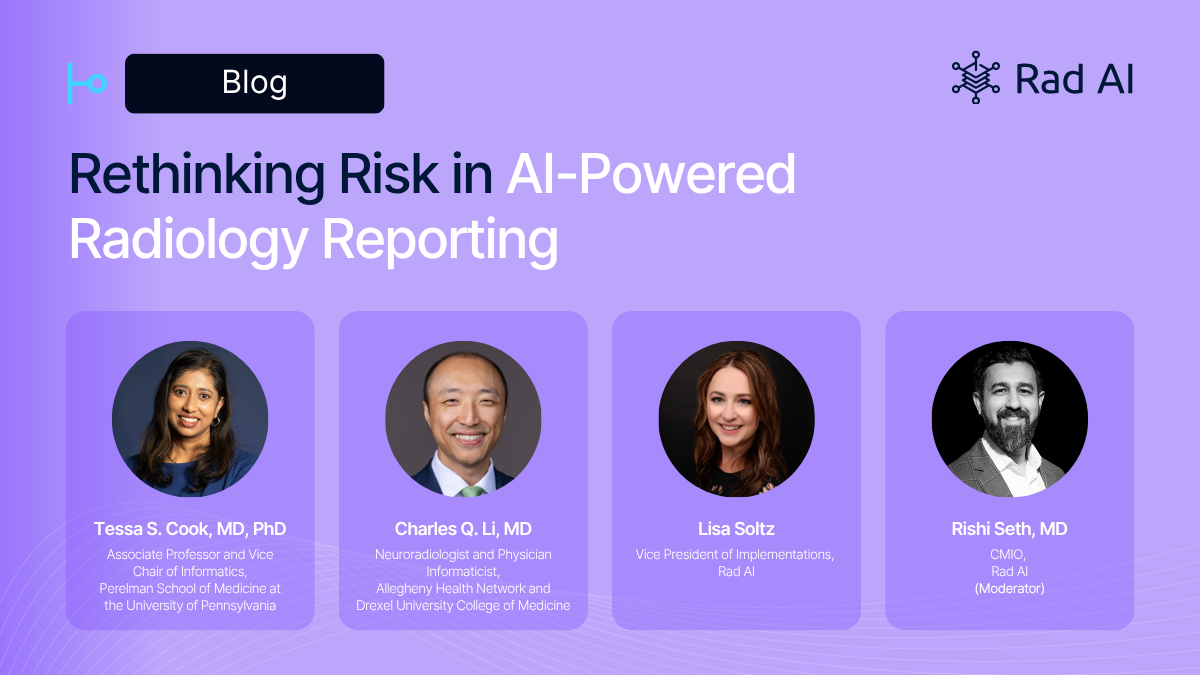
In a recent webinar, three healthcare technology leaders discussed how organizations can rethink what “safe” means when evaluating reporting platforms:
- Tessa S. Cook, MD, PhD, Associate Professor and Vice Chair of Informatics, Department of Radiology, Perelman School of Medicine at the University of Pennsylvania
- Charles Q. Li, MD, Neuroradiologist and Physician Informaticist, Digital Transformation Office, Allegheny Health Network; Associate Professor, Department of Radiologic Sciences, Drexel University College of Medicine
- Lisa Soltz, Vice President, Implementations, Rad AI
- Rishi Seth, MD, Chief Medical Information Officer, Rad AI (Moderator)
They discussed what AI changes about the evaluation, what radiologists need from a reporting platform and what it takes to introduce change without disrupting the fundamentals that already work.
Evaluation: What Friction Have You Learned to Accept?
Generative AI has introduced capabilities that simply weren’t part of the reporting technology conversation a few years ago. For Dr. Cook, that creates an opportunity to reconsider processes radiologists have learned to work around.
“For so many years, we have trained ourselves to compensate for the things that our systems that we use can't do for us,” she shared. “One of the really nice things about where the technology is today is that you can quite literally train the technology now to do those things for you.”
That shifts an important question in the evaluation. Instead of only asking about the disruption of changing, organizations should also consider the cost of staying with workflows that require unnecessary manual effort.
For organizations unsure where to begin, Dr. Cook recommended simply describing the current workflow. Doing so can quickly uncover “all the workarounds, all the little pain points that you just kind of accept because that's what we've got.”
Workflow: Preserve What Works, Improve What Doesn’t
Rethinking familiar workflows doesn’t mean changing everything.
For Dr. Li, reporting technology still needs to deliver on the fundamentals: turning a radiologist’s spoken words into text quickly and accurately.
“If a reporting solution can't do that with extreme accuracy and efficiency, then it's probably not viable for a lot of radiologists and a lot of radiology practices,” he said.
Beyond those fundamentals, radiologists have developed their own ways of working based on their subspecialty, preferences and experience. A new reporting platform should accommodate those workflows rather than force radiologists to adapt to the technology.
That flexibility is equally important during implementation. Soltz described implementation as “not just a technology implementation” but a “human change event.” Some radiologists may want to take advantage of AI immediately, while others first need confidence that they can continue working in familiar ways.
A successful transition should create room for both.
Validation: Look Beyond the Demo
With AI developing quickly, organizations also need to distinguish what works today from what exists primarily on a roadmap. Both Dr. Cook and Dr. Li emphasized the value of getting hands-on with technology and learning from peers at similar organizations.
“The best way to figure out if something is going to work is to be able to try it,” said Dr. Cook.
That means looking beyond a polished demonstration. Can radiologists test the technology themselves? Can the organization see how it performs in workflows similar to its own? And does the vendor have a track record of turning its roadmap into usable technology?
The partner behind the platform matters too. Reporting is deeply embedded in the radiologist workflow, making implementation, responsiveness and continued collaboration part of the evaluation.
As Dr. Cook put it, “We've found over time that it's really that collaborative relationship that leads to a lot more success.”
Partnership: Implementation Is an Enterprise Change
A reporting transition reaches beyond the reading room. IT infrastructure, integrations, governance and other technology initiatives can all influence an organization’s readiness for change. That makes shared ownership critical.
Soltz shared an example of a large academic health system where Rad AI brought product and implementation leaders on-site with the organization's IT team, radiology champions, administrators and project managers. Together, they spent a day and a half working through integrations, workflows and the requirements for both an initial pilot and a broader rollout.
The process aligned both teams on what needed to happen now, what could come later and who owned each part of the transition.
Rethinking the “Safe” Choice
The safest choice isn’t automatically the most familiar one, and a newer technology isn't automatically better.
A stronger evaluation looks at both sides of the decision: what works today, what friction has become normalized, what can be validated in real workflows and whether the technology and partner can continue evolving with the organization.
As reporting changes, so should the way organizations evaluate the risk of staying versus moving forward.
Watch the full webinar to hear the complete conversation on rethinking risk in AI-powered radiology reporting.

Expand Your Expertise
More Blogs
The Readout explores the technologies, challenges and realities shaping where care goes next.
%20(1).png)
Radiology-First AI
Radiology-first AI that works in the real world.
Built For How Radiology Actually Works
Built for Radiology. By Radiologists.