

How AI Reduces Cognitive Load in Radiology Workflows
Published
April 7, 2026
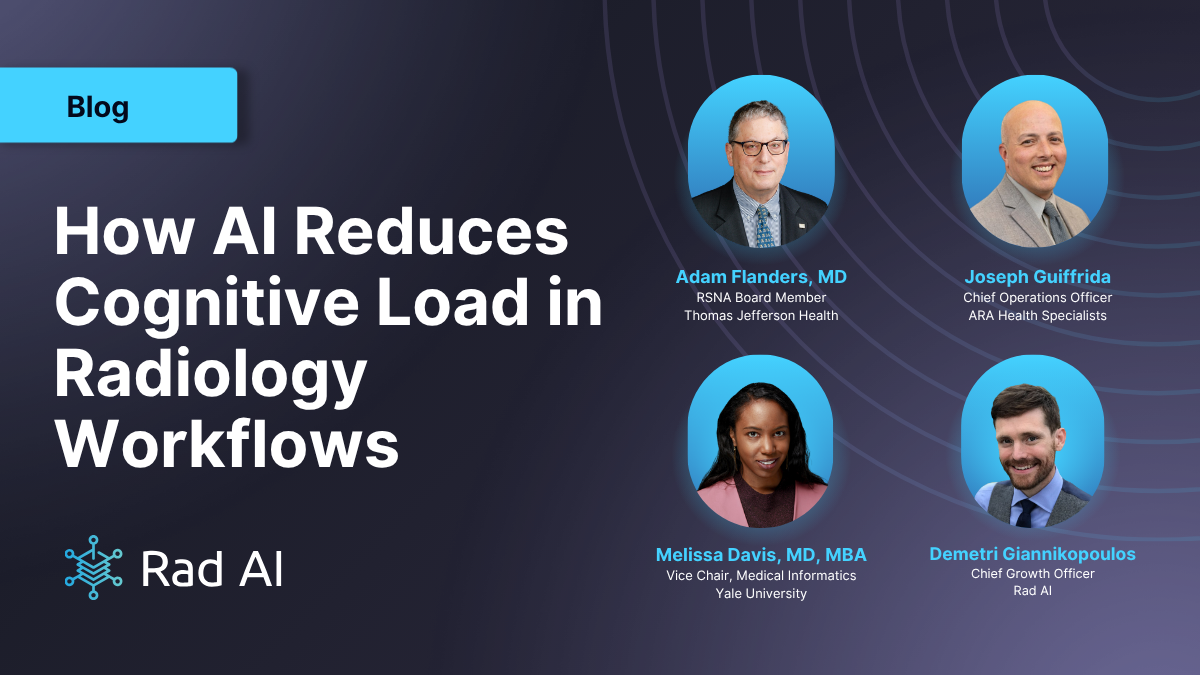

For a long time, the conversation around AI in radiology focused on performance: accuracy, speed and model outputs.
But that’s not what radiologists feel. What they feel — day in and day out — is cognitive load.
In modern radiology workflows, that comes from constant context switching, repetitive reporting tasks and the accumulation of small inefficiencies across hundreds of studies. None of it is dramatic on its own, but together, it becomes one of the biggest drivers of burnout.
In the webinar clip below, Demetri Giannikopoulos, Chief Innovation Officer at Rad AI, and Melissa A. Davis, MD, MBA, Vice Chair of Informatics at Yale University, discuss how AI in healthcare must integrate at the point of care to reduce cognitive burden — not add to it.
One of the challenges is that cognitive load is difficult to measure directly. Unlike turnaround time or report volume, there’s no single metric that captures it.
Instead, healthcare organizations are relying on a more practical signal: radiologist feedback.
- Do the tools reduce friction?
- Do they eliminate repetitive steps?
- Would radiologists actually miss them if they were gone?
That last question is often the most revealing.
If an AI tool is truly improving workflow efficiency in radiology, its absence is immediately noticeable. Increasingly, generative AI tools — especially those that assist with report summarization and impressions — are passing that test.
Not because they’re novel but because they address a real source of cognitive strain.
To hear the full discussion — including perspectives on deployment, governance and scaling AI across health systems — access the full on-demand webinar.

Expand Your Expertise
More Blogs
The Readout explores the technologies, challenges and realities shaping where care goes next.


%20(1).png)
Radiology-First AI
Radiology-first AI that works in the real world.
Built For How Radiology Actually Works
Built for Radiology. By Radiologists.