

Cracking the Code: What Makes Imaging AI Work? Key Takeaways from SIIM's #AskIndustry Panel
Published
July 9, 2026
.jpeg)
Deploying AI in imaging is no longer about proving that the technology works. The challenge today is making AI work reliably, sustainably, and at scale in real-world healthcare environments.
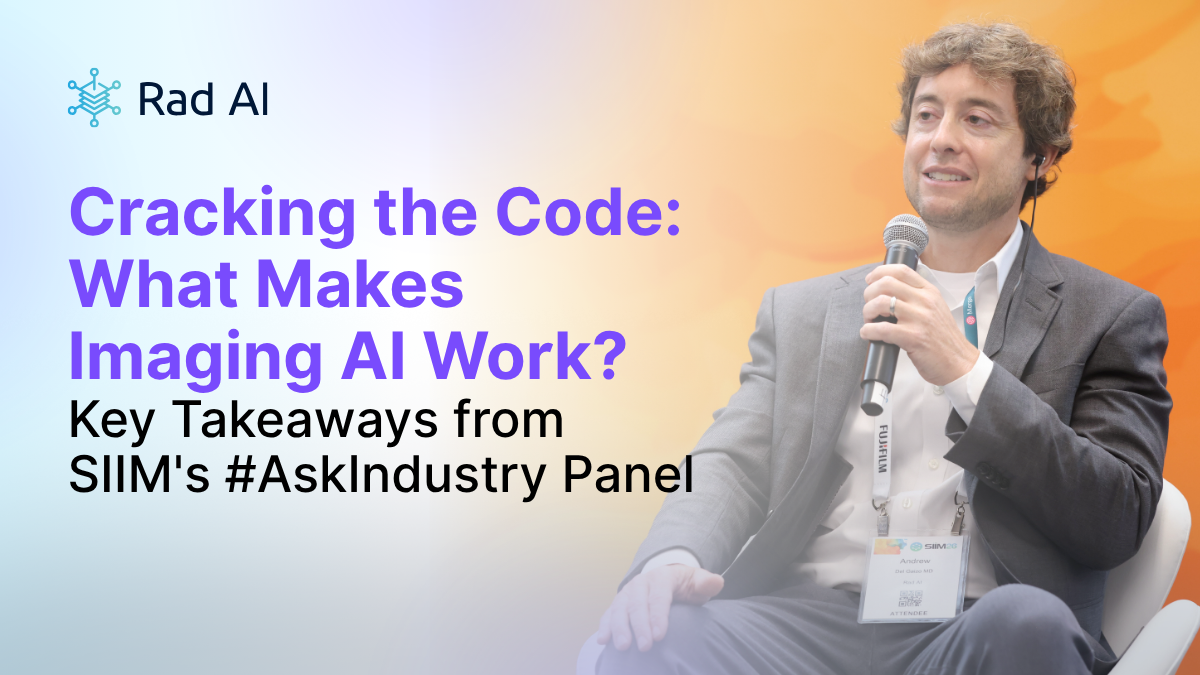
That was the focus of SIIM's panel discussion, "Cracking the Code: What Makes Imaging AI Work #AskIndustry," moderated by Katherine Andriole, PhD, Associate Dean for Health AI Strategy & Innovation at UCLA David Geffen School of Medicine.
The panel featured:
- Andrew Del Gaizo, MD, MBA, Chief Medical Information Officer at Rad AI
- Christopher Austin, MD, MSc, Global Medical Director at Lunit
- Heather Chait, MBA, DPM, AI Clinical Ecosystem Lead at Philips
Together, they explored what separates successful AI deployments from stalled pilots, from stakeholder alignment and workflow integration to governance, implementation support, and long-term monitoring.
Start with the Problem, Not the Technology
When asked what drives a successful AI implementation, the panelists agreed on one key principle: start by clearly defining the problem you're trying to solve.
Dr. Del Gaizo noted that organizations often move too quickly to evaluate technologies before fully understanding the pain point they hope to address.
He pointed to Rad AI Impressions as an example. The product was developed to address a specific challenge: radiologists were experiencing increasing burnout and spending significant time creating report impressions. Because the problem was clearly defined, it was easier to align on outcomes and measure success.
Dr. Austin emphasized identifying who will use the technology, what challenges they face, and what outcomes they hope to achieve before implementation begins. Chait expanded the conversation to the enterprise level, noting that successful AI adoption requires alignment across clinical, IT, legal, compliance, and operational teams.
"Implementation at enterprise scale takes a village," she explained.
The discussion underscored a common theme: successful AI deployment begins with clarity around goals, stakeholders, and expected outcomes.
Why Some AI Implementations Struggle
The panel also explored lessons learned from deployments that didn’t go as planned.
Dr. Del Gaizo shared an early implementation lesson: even when a solution performs well technically, adoption can falter if it doesn't fit the way clinicians work. In one rollout, users stopped using the solution because the output didn't feel personalized enough to their reporting style.
That feedback became a turning point, reinforcing the importance of personalization in clinical AI. For radiologists, a solution must not only be accurate but also feel natural to their workflow.
Dr. Austin highlighted another common challenge: expectation gaps. Organizations often have varying levels of AI familiarity among users, making education and expectation setting critical to adoption. Helping users understand what AI can and cannot do builds trust and supports long-term engagement.
Chait pointed to change management as one of the most overlooked aspects of implementation. Even with strong clinical champions, adoption can stall if the broader organization isn't prepared to support new workflows. Establishing governance structures and communication plans early can help organizations navigate change more effectively.
AI Governance Cannot Be an Afterthought
When asked what changes could make AI implementation easier, Dr. Del Gaizo highlighted the need for more standardized approaches to governance and monitoring.
The panel also emphasized the importance of establishing governance early. Chait noted that organizations that delay building governance structures often find themselves backtracking after implementation has already begun.
Organizations need clear answers to questions such as:
- Who is responsible for oversight?
- How will performance be measured?
- What happens if a model's performance changes over time?
- What constitutes acceptable performance?
Importantly, AI implementation does not end at go-live.
"Continuous monitoring is needed," Dr. Del Gaizo said, emphasizing that organizations should regularly evaluate whether AI solutions continue to perform as expected in real-world clinical environments.
The Critical Role of IT and Customer Success
An audience question focused on what helps organizations move efficiently from evaluation to deployment from an IT perspective.
The panel agreed there is no universal implementation formula. Every health system has its own infrastructure, cybersecurity requirements, workflows, and organizational priorities.
Dr. Del Gaizo emphasized the value of strong IT champions who can coordinate efforts, maintain stakeholder alignment, and identify challenges early. Close communication between clinical teams, IT departments, and vendors can significantly improve implementation outcomes.
Dr. Austin added that organizations should evaluate the size and maturity of a vendor's customer success team, not just the technology itself. Because every healthcare environment is different, successful implementations often depend on whether a vendor can provide the expertise, support, and flexibility needed to adapt to each organization's unique needs.
Key Takeaway: Successful AI Implementation Requires More Than Technology
While the panel covered everything from personalization and change management to governance and implementation support, one message stood out: successful AI adoption is about more than the technology itself.
Organizations that see lasting value from AI are those that clearly define the problem they're solving, prepare stakeholders for change, and build the processes needed to support long-term success.

Expand Your Expertise
More Blogs
The Readout explores the technologies, challenges and realities shaping where care goes next.
%20(1).png)
Radiology-First AI
Radiology-first AI that works in the real world.
Built For How Radiology Actually Works
Built for Radiology. By Radiologists.