

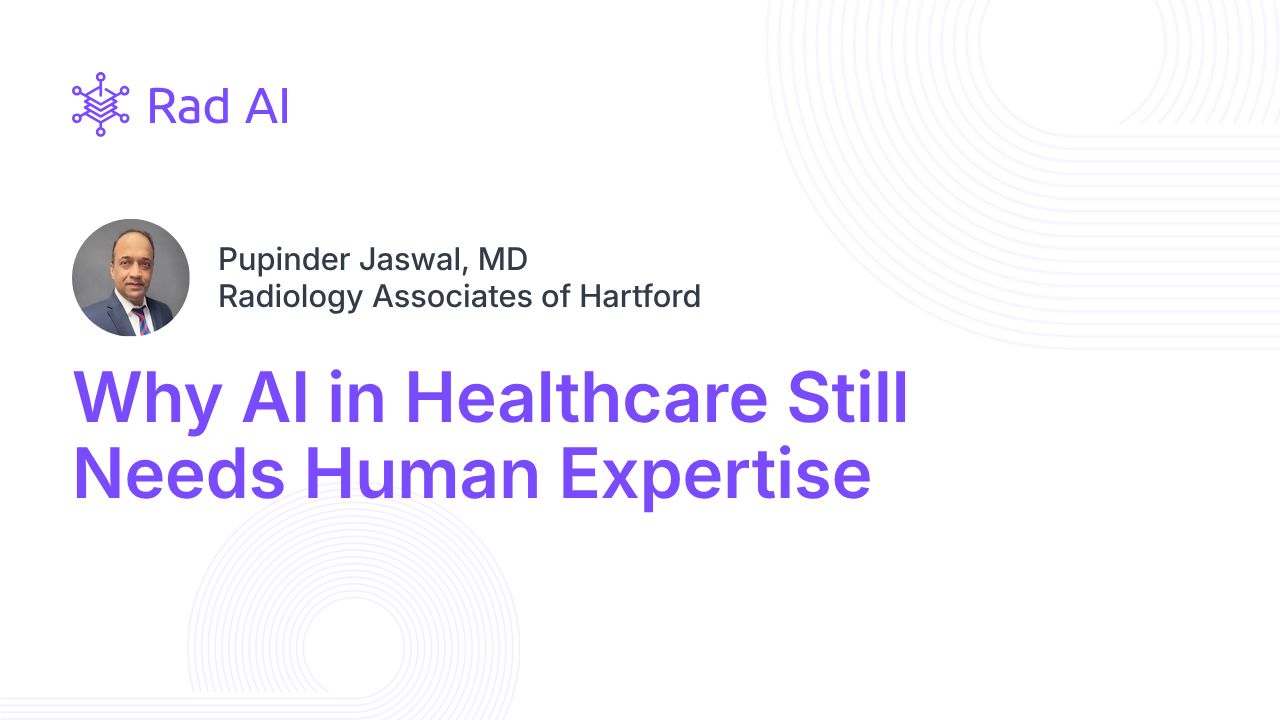
It’s 2026. Welcome to Healthcare AI’s Next Act: Prove It or Move Aside
Published
January 8, 2026


Every few years, healthcare crowns a new hero. For a while, attention centered on the electronic health record, less a hero than a handy proxy for deeper systemic frustrations. Then “digital transformation,” a phrase roomy enough to mean everything and nothing. Over the last half decade, the spotlight shifted to artificial intelligence.
AI was supposed to rescue clinicians from burnout, patch a shrinking workforce, restore margins and — perhaps most heroically — end the soul-crushing ordeal of clicking through eight screens to complete one task.
But as we enter 2026, it’s worth remembering something we seemed to forget: healthcare already has a hero, and it isn’t AI.
It’s the humans — clinicians and staff — who navigate regulation, administration and uncertainty every day to deliver care. If that sounds too obvious to be profound, that’s exactly why it needs repeating. Somewhere along the way, we began acting as if AI were the only thing capable of saving healthcare. If that were true, shouldn’t healthcare already be saved?
Dismantling the AI Hype Cycle
This will be the year when AI use cases finally separate into two categories: those that truly replace tasks and those that enhance human work.
Only a tiny fraction are fully automatable end-to-end. The rest will become hybrid workflows that strengthen clinical judgment rather than replace it. Any AI that fails to complement the clinician’s workflow will struggle for adoption. That isn’t cynicism, it’s operations. You don’t buy AI because it’s flashy. You buy it because it works.
Show, Don’t Tell
Alongside categorization comes the “prove-it phase II.”
Phase I demanded transparency: show us your model card, your data, your validation studies. Phase II asks tougher questions: What changed because of your tool? Did it reduce harm? Free up even five minutes of a clinician’s day? If the answer is no, it doesn’t matter how elegant your ROC curve looks.
Too many experiments never translate into real clinical use. Multiple studies make this gap explicit, including work out of Duke University estimating implementation costs over $200,000 and the MIT Nanda report’s finding of a 95% pilot failure rate. The pattern is consistent: pilots succeed on paper, then stall in practice.
In the REVEAL-HF trial, a well-validated mortality risk score that surfaced directly in the EHR failed to shift decisions or outcomes; most clinicians simply tuned it out. In a recent evaluation of the Epic Sepsis Model, overall AUROC (area under the receiver-operating characteristic curve) looked respectable, but accuracy collapsed at the earlier time points when early intervention matters. A model can perform beautifully in aggregate and still fail in the only moments clinicians need it.
Sometimes the most effective metrics are the simplest.
At the Johns Hopkins Research Symposium on Engineering in Healthcare in December, Andrew Menard, executive director for radiology strategy and innovation at the Johns Hopkins Health System, described how his team evaluated a breast cancer AI tool for early detection and risk prediction.
He did not begin with utilization curves or sensitivity charts. He asked radiologists one question: “Do you sleep better at night?”
The answer was overwhelmingly yes.
That answer mattered. It reflected trust and clinical confidence. On that basis, the organization moved the technology out of pilot mode and into routine clinical use. In an industry exhausted by pilots that never scale, clarity beats complexity.
The fatigue spreading across the industry isn’t a rejection of AI, it’s a rejection of hype. And that fatigue is healthy. It reminds us that AI is not the heart of healthcare; clinicians are. Tools must work for them and with them, not against them.
Enough Already
This shift also exposes the flaw in a popular stance heard on conference stages lately: that autonomous AI should never be allowed in healthcare. The stance sounds principled, but it’s ultimately naive.
If autonomous systems vanished tomorrow, we’d have to strip automated interpretation from nearly every EKG machine. Automated interpretation didn’t begin with deep learning; it began with the line of text printed on a paper strip. Even the first FDA-cleared autonomous model, IDx-DR, didn’t invent autonomy, it formalized it.
The real issue isn’t autonomy. It’s the widening gap between regulation, accreditation and clinical practice. Those three areas are colliding, and when they do, reality tends to win or force everything else to change.
It’s also time to admit that AI often isn’t novel. It’s a more automated version of workflows we’ve had for years. Which raises a question the industry rarely says out loud: when an AI makes a mistake, who absorbs the liability? Today, it’s almost never the vendor. That reality shapes the complex procurement, governance and clinical behavior. Until that changes, AI will remain a tool — not a replacement — and certainly not the protagonist.
Re-Centering the Human in Healthcare
The real story of 2026, however, may be the return to the human center of healthcare.
After years of breathless promises and valuations that never materialized — just ask the ghosts of marketplaces past — the industry expects more. That is why the compass is pointing again toward people, not algorithms. AI will continue to shape healthcare in powerful ways, but it is not the main character.
Healthcare doesn’t need a new hero; it needs better tools for the heroes it already has. The companies that understand this, those that build for enhancement, not replacement, will gain traction. Those that don’t will write compelling postmortems about why “the timing wasn’t right.”
Meanwhile, clinicians will keep doing what they’ve always done: showing up for patients, navigating uncertainty and applying judgment under pressure. They will continue to remind us, quietly but unmistakably, that the center of healthcare has always been human — no matter how impressive the software becomes.
Editor note: This article originally appeared on Forbes.com

Expand Your Expertise
More Blogs
The Readout explores the technologies, challenges and realities shaping where care goes next.
%20(1).png)
Radiology-First AI
Radiology-first AI that works in the real world.
Built For How Radiology Actually Works
Built for Radiology. By Radiologists.